
.avif)

Key Takeaways
Why read this article?
To understand how 180DC branches can move beyond cold outreach pitches by offering real client value upfront, making conversations more compelling and productive.
Why is it important?
Nonprofits and early-stage organisations often sense problems but struggle to define them clearly. Maturity assessments, central to A Tool to Sell More, help uncover root causes, and significantly improve project conversion and impact.
What will you learn?
You’ll learn how maturity assessments differ from surveys, how leading consulting firms use them and benchmarks to win work, how branches can reuse insights from past projects, and how AI can accelerate the creation of high-quality, practical diagnostics.
How will this benefit you personally?
You’ll be better equipped to lead confident client conversations, win better-scoped projects, and deliver value from the first interaction. Most importantly, develop consulting skills that recruiters actually value in the real-world.
Every year, 180 Degrees Consulting branches compete in a crowded landscape of student consulting teams, all eager to win meaningful projects and support initiatives that drive social impact. Yet the very organisations they hope to serve like non-profits, early-stage start-ups, and small businesses, often don’t have the clarity, structure, or diagnostic insight to articulate what help they truly need. Many know something feels “off” , but not what. Others are juggling urgent symptoms without understanding the root cause. In this gap lies both the challenge and the opportunity.
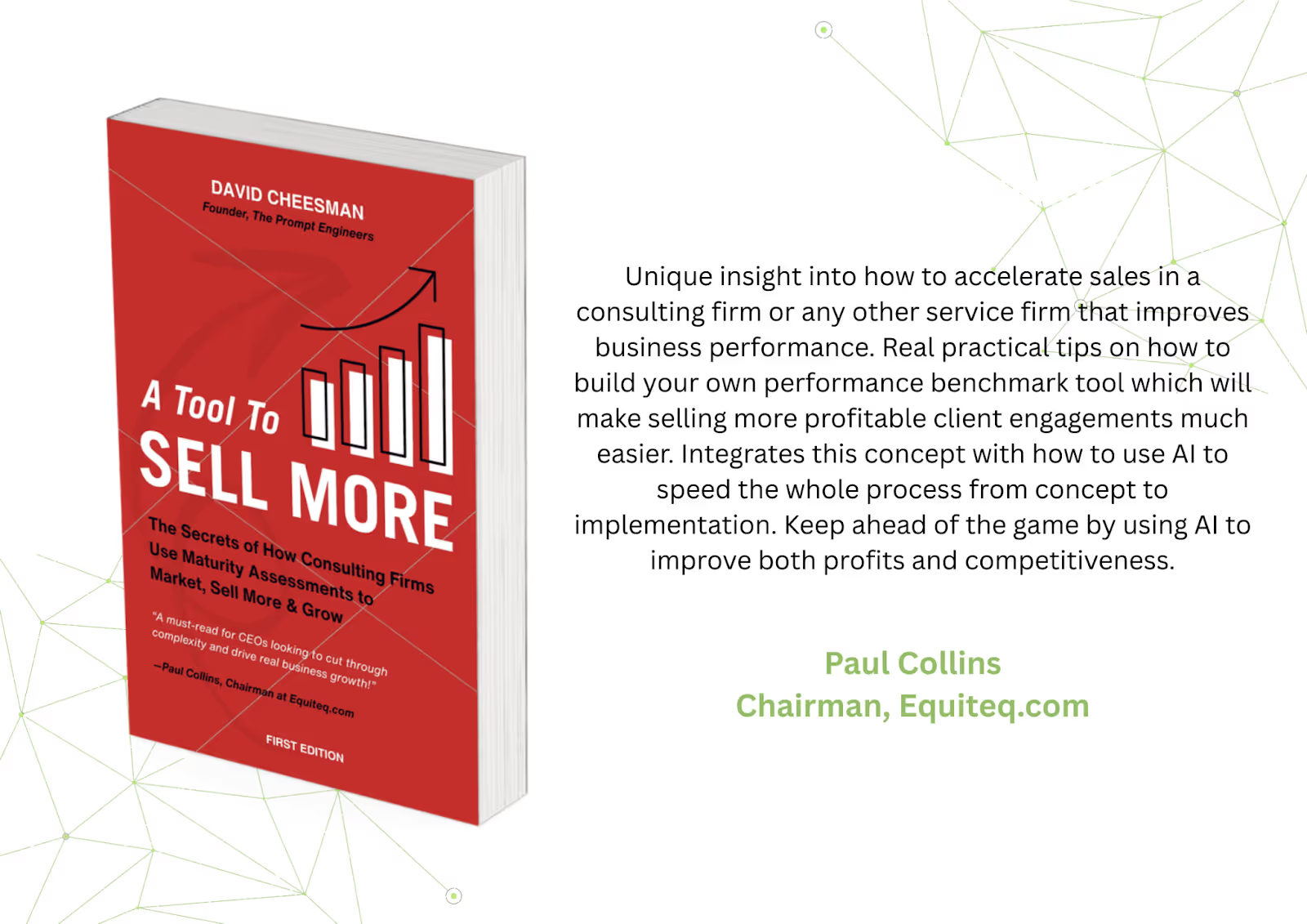
A Tool To Sell More, David’s structured playbook on building maturity assessments and diagnostic frameworks, will offer a distinctive edge to 180DC branches. It enables teams not just to pitch harder, but to engage smarter, by helping clients understand themselves better. This article explores how the book can elevate business development efforts across 180DC, enhance client value delivery, and transform the way branches synthesise knowledge from past engagements.
Many nonprofit and small-business leaders are accustomed to surveys that are simple sets of questions that collect opinions and perceptions. But surveys rarely diagnose. They illuminate symptoms, not systems. Maturity assessments, by contrast, offer a structured way to understand where an organisation truly stands across capabilities, processes, behaviours, and infrastructure. They help uncover the bottlenecks clients often cannot articulate, and the root causes behind everyday frustrations. I remember a conversation I had with David while working on the book, where he put it simply: “Surveys are targeted on people and preferences, while maturity assessments are targeted on organisations and processes. ”
Building assessments that go beyond data collection into genuine insight generation, gives branches a repeatable, defensible framework they can use before the project begins, establishing credibility, and aligning on what really needs fixing. This becomes particularly critical in the context of small organisations, which would typically not engage external consultants, let alone student teams, to find the problem. They believe they already know their pain point (“we need more donors” , “we need better operations” , “we need a marketing strategy”). Yet, more often than not, the challenges they articulate are merely downstream symptoms of a deeper constraint, the very constraints maturity assessments are designed to reveal.
Major consulting firms across the world follow a clear client acquisition strategy: they lead with diagnostics, and monetise problem-solving. A robust assessment, whether in the form of a maturity model, benchmarking exercise, or capability diagnostic, helps clients to see gaps themselves. This establishes credibility early, while demonstrating tangible value, before any delivery engagement begins. And it dramatically raises the likelihood of a successful project conversion.
In the impact and social sector consulting space, this approach becomes even more crucial. Unlike corporate environments, where processes are standardised and decision-making structures are well-defined, many nonprofits operate with complex stakeholder ecosystems, resource constraints, and varying levels of organisational maturity. Here, client development and onboarding often matter more than the actual solution delivery, because:
Thus, structured diagnostics serve as both a value creation mechanism and a relationship-building tool. They help clients recognise the urgency and scale of their organisational challenges, while providing consultants with the insights needed to design high-impact, context-sensitive interventions. This very philosophy underpins A Tool to Sell More: it brings together a suite of diagnostic frameworks, spanning industries and organisational capabilities, each tailored to real-world use cases. The intention is not just to showcase tools, but to empower practitioners to engage clients more effectively, diagnosing precisely, building confidence early, and co-creating solutions that truly fit the environments they serve.
At present, most outreach from student consulting teams involves asking clients for a conversation, or providing a set of examples from past engagements for clients to distill the value. But this distilling is a consultancy’s job. Clients expect value upfront. The shortcoming in the current approach lies in the fact that it delivers little value that has immediate utility.
Imagine a cold email that says:
“Our team helps organisations strengthen strategy, operations, fundraising, and digital engagement through pro-bono consulting projects each semester. We’re currently onboarding new clients and would love to understand your priorities for the coming months. If you’re available, we’d be happy to set up a short call to learn more about your work and explore whether we could support your organisation. The team has previously worked with ABC organisations and created XYZ impact. ”
Now consider an alternative approach inspired by A Tool To Sell More:
“Based on our nonprofit maturity benchmark built from 20+ organisations across our 180DC client network, we believe your team may benefit from a free 10-minute diagnostic. It will show where your organisation stands across fundraising, operations, digital capability, and volunteer management. If helpful, we can share a brief insight report and walk you through areas where organisations like yours typically see bottlenecks. ”
This transforms the conversation.
Instead of asking for a meeting, you offer insight.
Instead of pitching expertise, you demonstrate value.
A Tool To Sell More gives branches all the foundational elements needed to design these diagnostics effectively.
Across the global 180DC network, one of the greatest missed opportunities is how frequently branches repeat the same types of projects: fundraising strategy, digital marketing, impact measurement, scaling operations, volunteer management, and process redesign. Each team starts from scratch, even though dozens of other branches have tackled near-identical problems before. There are scattered learnings, some qualitative insights passed from one semester to the next, but true like-for-like comparison of common pain points remains rare.
Even within a single branch, multiple engagements circle around the same challenge year after year. The real opportunity lies not in doing more projects, but in synthesising what already exists into structured and standardised knowledge that becomes comparable across clients and locations. This is not just documentation, it is an art of designing maturity assessments. And that is precisely what David teaches in this book: from defining capabilities, sub-dimensions, and indicators, to building scoring models and diagnostic questions, along with a practical review of technology platforms that can support this work.
This approach is grounded in a powerful idea the book emphasises repeatedly: the interplay of knowledge. When maturity assessments are built on the cumulative experience of past projects, they get smarter. Benchmarks sharpen, and recommendations become more targeted. Branches stop reinventing the wheel. A shared diagnostic, built once, can be applied across dozens of engagements and can be continuously refined by real-world use, improving each time it’s deployed. The book shows exactly how to build and evolve these shared tools into institutional knowledge that strengthens consulting quality across the network.
This is also how professional consulting firms differentiate themselves. BCG has its i2i Innovation Benchmarking Tool. McKinsey has the McKinsey Design Index (MDI). Bain has the NPS system. These aren’t just intellectual property, they are business development engines, allowing firms to demonstrate value before they are hired. Yet 180DC branches rarely leverage their own collective experience in this way, even though they could and should.
One of the examples (pertaining to the public sector), already quoted in the book, illustrates this perfectly: BCG’s AI Maturity Matrix, a maturity-led diagnostic that evaluates how prepared different economies are to adopt and benefit from AI. It assesses readiness across multiple levers including ambition, skills, policy and regulation, research and innovation, and ecosystem infrastructure. Each economy is then placed into an archetype, such as “AI Pioneers” or “Rising Contenders, ” enabling a like-for-like comparison with peers. The result is not just a score, but a clear picture of strengths, bottlenecks, and priority focus areas. This kind of framework turns broad concepts into structured insight that policymakers can act on. It demonstrates exactly how a maturity model can combine diagnosis with benchmarking to inform targeted improvement plans. And the same logic can be applied to nonprofits: define capabilities, score performance, benchmark against similar organisations, and turn the findings into a compelling starting point for conversation and support.
Even a simple diagnostic, a handful of questions producing a score, such as using an S-Curve, can help visualise where the client stands on an improvement journey. David demonstrates this brilliantly in the AI Readiness Assessment (yes, go take it for your branch!). The book lays out the full architecture behind such a maturity assessment, so any branch can build assessments in fundraising, digital, operations, or impact measurement, without guesswork. It starts by defining the assessment domains, that is, the capability areas being evaluated. Within each domain, indicators are selected to capture what “good” looks like, in specific, observable terms. These are mapped to maturity levels that show progression from basic to advanced performance. Evaluation methods then determine how evidence is collected like surveys, interviews, document reviews, or data analysis. The structure becomes a maturity model when these elements are standardised for repeat use across clients. Once multiple organisations are assessed, benchmarking reveals where each client stands relative to peers. Finally, the assessment generates actionable insights and roadmaps, turning scores into clear priorities and next steps. Together, these components ensure that diagnostics move beyond opinion, into evidence-based guidance that clients can trust.
Many student teams struggle with the leap from theory to practice. So the book doesn’t stop at principles, it includes a full, end-to-end SaaS FinTech case example to show how to translate the framework into a working maturity assessment. It is concrete, detailed, and replicable, giving branches a real reference point for execution. This can be summarised in the graphic below, which illustrates the pathway from scattered learnings to structured diagnostics that improve every project that follows. Moreover, Monday.com, already available across the network, can serve as a starting place for building such tools and putting this approach into practice.
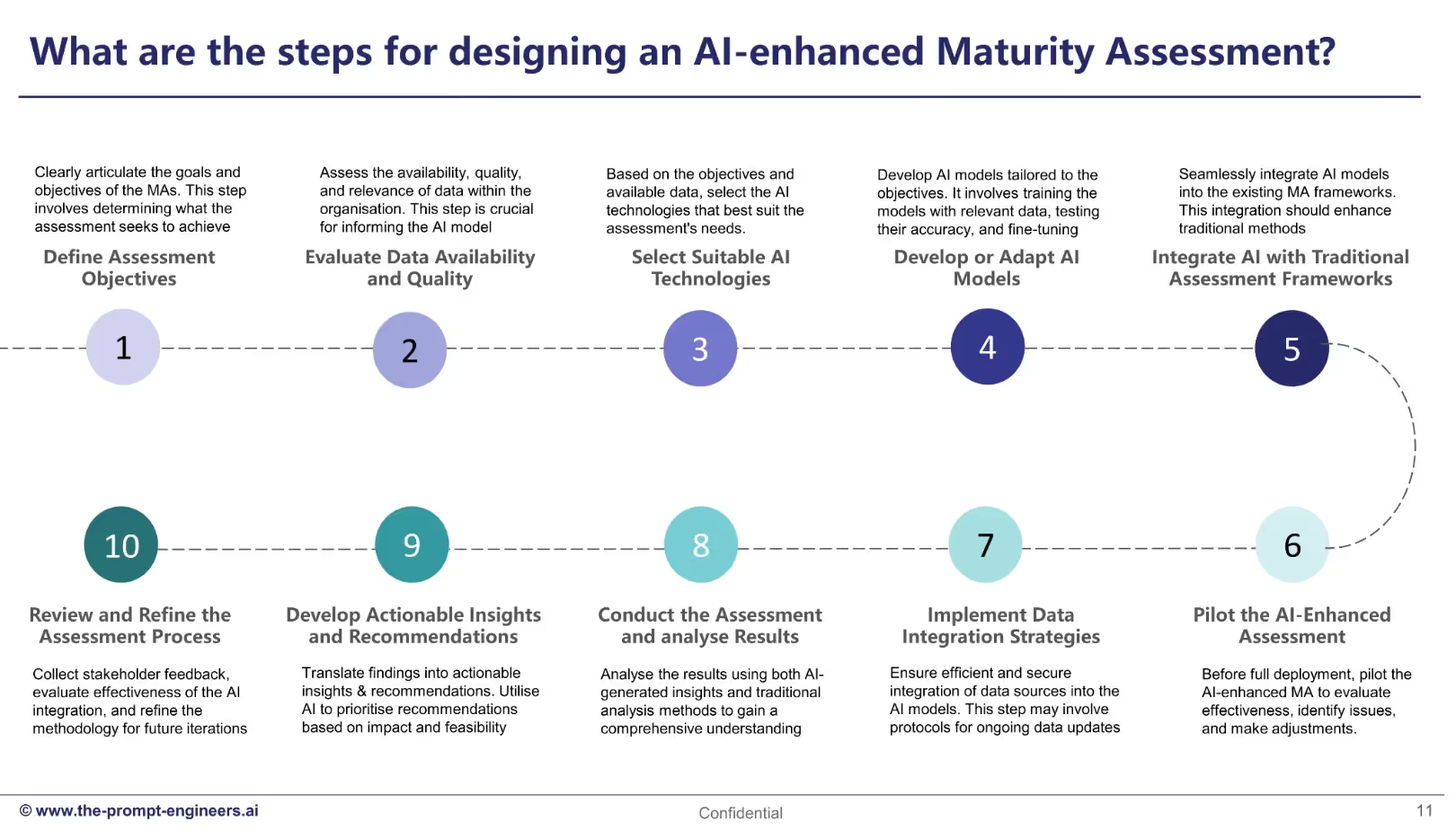
And now, with the rise of AI, student consulting teams no longer need to start from a blank page. AI can rapidly generate the foundations of any diagnostic: initial capability maps, draft maturity levels, evaluation rubrics, sample questions, and even visual scoring outputs. This dramatically accelerates the hardest part of the process, getting the first version out of someone’s head and into a usable structure. Branch mentors, especially alumni currently working in consulting can then shape and refine these drafts into professional-grade tools grounded in real practice. The book provides intellectual rigour; AI provides scale and speed; mentors provide judgement and nuance. Together, this allows any branch to build high-quality diagnostics in days, not months.
More importantly, AI is shifting the bar on what clients expect from their consulting partners. Organisations increasingly judge value by how quickly insight is surfaced and how tailored that insight feels to their reality. AI has conditioned leaders to expect instant baselining, predictive signals, pipeline visibility, and decision-ready insights from the very first interaction. Delivery models that depend on long discovery phases or manual analysis no longer feel acceptable when AI can automate the basics and spotlight the patterns that matter. In short: value cannot just arrive at the end of the engagement, it must show up early, continuously, and unmistakably.
This mirrors what professional consulting firms are already experiencing. Based on years of deploying benchmarking propositions and now AI-enhanced versions, the outcomes are markedly stronger. With AI in the mix, teams can identify and qualify leads in a streamlined fashion , generate tailored proposals in minutes, predict conversion likelihood with greater accuracy, and eliminate a huge amount of repetitive pre-sales work. The fundamentals of selling become more efficient, leaving consultants focused on genuine insight and stakeholder change. Put simply: more business, less effort, a fraction of the time. And when benchmarks dynamically update across a portfolio of clients, the benefits multiply again - AI becomes the engine doing the work, not just the judgement layer. The re-analysis of Equiteq’s white paper in the book quantifies the same as shown in the figure below.

Ultimately, this will help transform the way 180DC branches learn, sell, and deliver, changing the trajectory of every engagement before it even begins. It is about turning years of repeated work into shared wisdom, what Elon Musk famously calls collective consciousness, here with a twist of collective system knowledge. Turning scattered insights into structured, compelling value. And turning student teams into strategic partners, equipped with tools that unlock better conversations, better projects, and better impact from the very first touchpoint.
A Tool To Sell More gives 180DC branches an opportunity to fundamentally rethink how they win projects and how they deliver value. It shifts the question from:
“How do we convince organisations to work with us?”
to
“How do we equip organisations to see exactly how we can help them?”
The difference is subtle, but transformative. By developing maturity assessments, using benchmarks, synthesising knowledge across engagements, and offering diagnostic value upfront, branches can stand out in the eyes of clients, while elevating the quality and impact of their work.
This article was written by David Cheesman (Founder @ The Prompt Engineers and Board Advisor at 180DC's GLT) and Navya Agarwal (Ex-Specialist, at 180DC's GLT)
A Tool to Sell More; The secrets of how consulting firms use maturity assessments to market, sell more and grow. The Prompt Engineers, https://amzn.in/d/8zqhSS6
i2i Innovation Benchmarking Tool. BCG, https://www.bcg.com/capabilities/innovation-strategy-delivery/innovation-benchmarkingtool
McKinsey Design Index (MDI). McKinsey & Company, https://solutions.mckinsey.com/design-index/
Net Promoter Score (NPS). Bain & Company, https://www.bain.com/consulting-services/customer-strategy-and-marketing/net-promoterscore-system/
AI in the Public Sector. BCG,https://www.bcg.com/publications/collections/ai-in-the-public-sector AI Readiness Assessment. The Prompt Engineers, https://www.theprompt-engineers.ai/ai-readiness-assessment
Cheesman, David, Bruce Ramsay, Tony Rice. Consulting Sales Growth White Paper. Equiteq, 2009, https://www.consultingnewsline.com/Info/Tribune/Forum/Equiteq/Consulting_Sales_Growth_White_Paper.pdf
 Read The Report


Are you a student who wants to make a difference while gaining valuable skills? Join 180 Degrees Consulting and become part of a global network of social impact leaders.
Find a 180DC branchAre you part of an organisation that is interested in working with a team of smart, driven consultants that will help you address key challenges you are facing? Explore our different services offerings, and reach out to us for a discussion - we look forward to speaking with you!
Work with usAre you interested in partnering with 180 Degrees Consulting to further our mission of enabling non-profits and social enterprises to scale their impact, while empowering the next generation social impact leaders? Reach out to us for a discussion.
Partner with usAre you a student who wants to develop the next generation of social impact leaders at your university? Start a branch today and be at the forefront of social impact in your community!
Learn more
2026 © Copyright 180 Degrees Consulting.
Handcrafted by Studio Sondar.
Privacy Policy. Cookie Policy.


